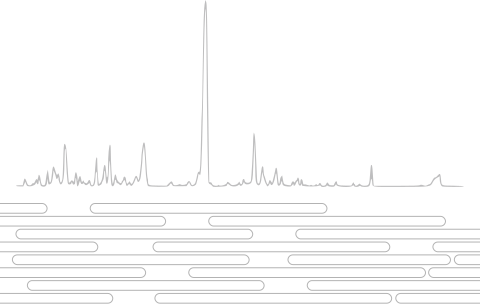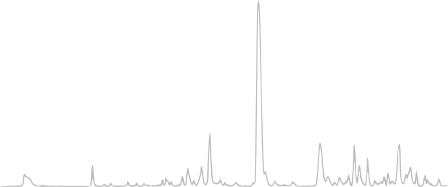

Shotgun metagenomics reads across 120,000+ genomes, with key species resolution at strain level.
Detect microbes down to a 0.005% relative abundance for the most clinically relevant findings


Gold-standard shotgun metagenomics, powered by proprietary bioinformatics and the field’s largest longitudinal dataset.
Shotgun metagenomics reads across 120,000+ genomes, with key species resolution at strain level.
Detect microbes down to a 0.005% relative abundance for the most clinically relevant findings
Bacteria, fungi, viruses and parasites, not a fixed panel of pre-selected targets.
Knowing which microbes are present is not the same as knowing what they are doing. We measure both.
Created and benchmarked against a longitudinal dataset of 200,000+ microbiome samples and counting, representing a wide range of ages and health backgrounds.
From swab to result, every sample goes through rigorous quality control and every report is reviewed by a scientist before release.
83% lower odds of infant eczema in a randomized controlled trial, published and peer reviewed.
Read studyTwo strains of the same species can affect health very differently. We sequence deep enough to tell them apart.
We sequence the full community across 120,000+ genomes and resolve hundreds of probiotic and pathogenic strains by name.
View Sample ReportAnalyzing every organism in a sample:
not just a fixed panel of pre-selected targets.

Bacteria, fungi, viruses, parasites and archaea, detected down to 0.005% relative abundance.
Knowing which microbes are present is not the same as knowing what they are doing. We measure both.
Microbes and their functions, side by side.
Functional gene capacity
from sequencing
Short-chain fatty acids from
gas chromatography
A six-month-old's gut is meant to look nothing like an adult's. Read against adult ranges, healthy looks abnormal.
51
Your age
60.3
Your microbiome age
This metric measures your biological age based on your microbiome, adjusted for male reference ranges.
Over 500 reference ranges benchmarked by age, so results are read against the right normal.
View Sample Report51
Your age
60.3
Your microbiome age
This metric measures your biological age based on your microbiome, adjusted for male reference ranges.
Every sample follows the same controlled path, from a swab taken at home to a result reviewed by a scientist before release.
A dry swab taken at home in under five minutes. Desiccant technology preserves microbes on contact and inactivates them, so the sample stays stable at room temperature for up to four weeks with no refrigeration.
Microbial DNA is extracted and sequenced in a CLIA-certified, CAP-accredited, high-complexity US laboratory. Samples run in batches, which takes two to three weeks.
Raw sequence data runs through our own bioinformatics platform, built in house, identifying every organism present and the functional genes they carry, down to 0.005% relative abundance.
Our proprietary reference engine plots each result against ranges matched to the patient's age, sex and life stage, drawn from one of the largest curated microbiome datasets in the field.
Every sample passes a series of quality control checks and expert review before results are released. This final stage takes two to three business days.
High-resolution data is only useful if it means something. We translate 147 metrics into patterns linked to real conditions, by age.
Patient Notes
68 year old male interested in weight loss. BMI 29, body fat 29.5%, visceral fat 3.2 L
HTN, high cholesterol, GERD, ulcer, hiatal hernia. Reports stomach problems whole life, cramps, diarrhea. No recent antibiotics. FHx: CAD, dementia, stroke, leukemia.
Diet: Frequent processed meat, artificial sweeteners, alcohol, modest plant intake.
Tiny Health Adult Gut Health Test.
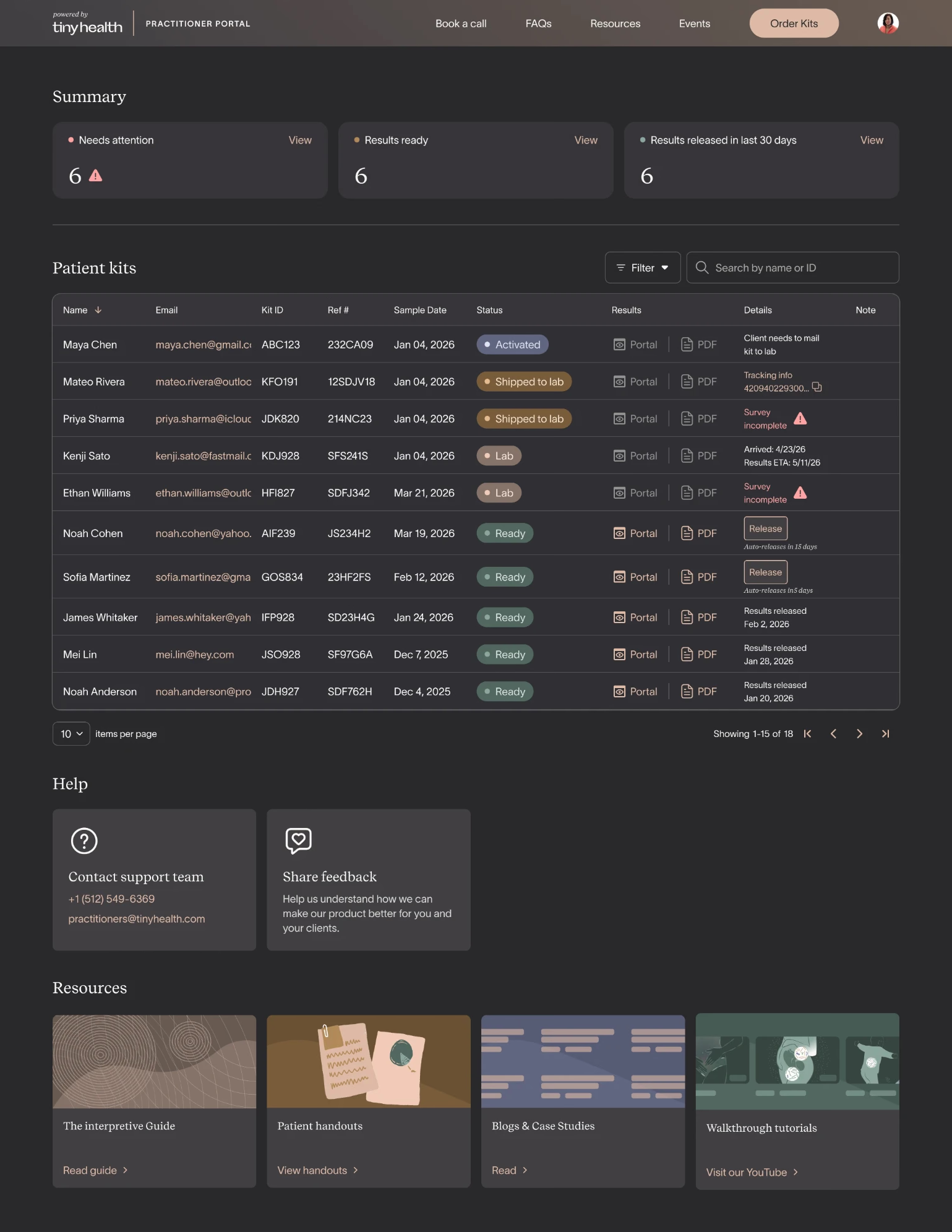
Our methods are tested the way clinical tools should be: in randomized trials, in peer-reviewed journals, and head to head against the tools you already use.
The people who built the platform also set the reference ranges, review the science, and stand behind every result you read. Microbiologists, immunologists, clinicians and academic researchers who shape how our tests are designed, validated and interpreted.

Pamela Nieto, PhD
Microbiome Researcher

Kimberley Sukhum, PhD
Chief Science Officer

Rodney Dietert, PhD
Immunologist, Cornell

Dr. Emeran Mayer, MD
Gut health expert & author

Ruben Mars, PhD
Microbiome scientist, Mayo Clinic

Dr. Elisa Song, MD
Chief Medical Officer

Noel Mueller, PhD
Epidemiologist, Johns Hopkins

Nicole C. Rankins, MD, MPH
OB/GYN & medical advisor

Meghan Azad, PhD
Pediatrics researcher
Straight answers on method, limits and data, including the places where our test is not the right tool.
Our reference dataset is one of the largest proprietary microbiome collections in the field. Rather than aggregating public data, every input is curated and structured specifically for clinical interpretation, then stratified so results are compared against people of the same age and life stage.
Yes. Sequencing reads genetic material from both viable and non viable cells, and that is true of every DNA based method including qPCR panels.
In practice this is rarely a limitation. The gut community turns over continuously, so the overwhelming majority of DNA recovered comes from a living population. Where viability matters most, the PRO test measures the products of microbial activity directly, including short chain fatty acid concentrations by gas chromatography. You can read genetic potential and measured output side by side rather than inferring one from the other.
DNA is chemically stable, which is the main reason we sequence it rather than RNA. RNA degrades quickly after collection and introduces variability between runs, which makes it poorly suited to tracking change over time.
Our collection uses validated desiccant technology that preserves the sample on contact and holds it stable at room temperature, removing shipping conditions as a source of drift.
Facilitate microbiome testing for your patients.
Learn moreEnd-to-end microbiome study execution.
Learn moreWhite-labeled microbiome testing via API.
Learn more